strkBTC is Live: Private Bitcoin Arrives on Starknet

Bitcoin is the most sovereign money ever created. It is also the least private money people have ever used. For fifteen years, that contradiction was a feature, not a bug. The same transparency that made Bitcoin trustworthy was the cost of running a financial system anyone could verify. The world has changed since 2008. The … Read more

The Federation supporting strkBTC infrastructure 

Bitcoin launched in 2009 and introduced a globally accessible digital asset whose ownership, supply, and transfers could be publicly verified. It also introduced a gap: financial activity using that asset became public by default. That gap matters. Universal visibility may not be suitable for all financial use cases. There is an undeniable need for verifiable … Read more

Why privacy is the missing piece for Bitcoin in DeFi

Bitcoin was meant to carry privacy. Even if that wasn’t the headline of the project, it was woven into how the system was supposed to work. The cypherpunk vision was money that didn’t ask permission and didn’t announce itself. The whitepaper spelled out one piece of that: use a fresh address every time so your … Read more

Native BTC to strkBTC Powered By Atomiq and Garden

Bitcoin is the most trusted digital asset in the world, but every balance, counterparty, and transaction is public forever. strkBTC changes that. It is a Bitcoin wrapper on Starknet, created when native BTC is deposited through the bridge, designed to let holders access private transactions, yield opportunities, and movement between shielded and public states. Supporting the rollout of strkBTC at launch, Atomiq and Garden will serve as key partners for direct BTC to strkBTC transfers, making it easier than ever for Bitcoin holders to make their Bitcoin productive and private.

Atomiq: Infrastructure for Direct BTC to strkBTC 

Atomiq is set to launch the infrastructure for direct BTC to strkBTC bridging, bringing Bitcoin liquidity onto Starknet with speed, privacy, and institutional-grade security. Atomiq will provide the infrastructure for a direct native BTC to strkBTC route. The user-facing transfer flow will be made available through a separate frontend, with final launch details to be confirmed.

Atomiq is a trust-minimized cross-chain DEX purpose-built for direct Bitcoin swaps. It uses UTXO-controlled vaults and an onchain Bitcoin light client to verify settlement through Bitcoin’s own consensus, giving users a non-custodial path into Starknet with no per-swap liquidity lock-ups. Rather than relying on escrows or timelocks, Atomiq leans on Bitcoin’s UTXO model as the settlement backbone: a liquidity provider deposits destination assets into a vault on Starknet, while users and LPs cooperatively sign a single Bitcoin transaction that atomically executes both sides of the swap. Once the Bitcoin network confirms the transaction, the vault verifies it via the onchain light client and releases funds on Starknet representing the deposited BTC, minus network fees.

BTC to Starknet transfers settle in roughly 20 minutes, or two Bitcoin confirmations. Transfers from Starknet to BTC through Atomiq’s infrastructure can be sent in a few seconds, following L2 finality. The BTC-side path is slower than a typical cross-chain swap, but the experience remains trust-minimized end to end. Users can also choose whether to shield their strkBTC during the transfer flow, adding optional privacy when moving BTC into Starknet.

Before each transfer, Atomiq screens incoming funds through Elliptic, an independent third-party compliance provider. 

Garden: Expanding BTC Distribution

Garden Finance will expand its cross-chain protocol to support BTC and WBTC (Wrapped Bitcoin) swaps into strkBTC, giving Bitcoin holders another route into Starknet.

Garden connects Bitcoin to Starknet through a different model than Atomiq. With over $2B in cumulative DEX volume, it has built a strong profile around intent-based cross-chain execution and has become an important venue for BTC liquidity moving across 18+ ecosystems. 

The protocol works through an intent-based system: users sign an intent to swap, solvers compete to fill it, and settlement happens through atomic HTLC-based swaps on both chains. This model supports a range of BTC variants, letting users route from multiple BTC sources into Starknet while preserving non-custodial guarantees from start to finish, in as quickly as 30 seconds.

This will give users an additional strkBTC on-ramp for BTC holders already active across DeFi, with solver competition helping improve execution and atomic HTLC settlement keeping the swap trust-minimized.

What You Can Do With strkBTC

Atomiq and Garden will give Starknet two distinct but complementary BTC on-ramps: Atomiq powers a direct native BTC to strkBTC route through dedicated infrastructure, while Garden expands access from BTC and WBTC liquidity across the broader crypto ecosystem.

Once you hold strkBTC, you can put it to work on Starknet:

  • Transfer: Use Garden, or access the Atomiq-powered BTC → strkBTC route through a dedicated frontend to be announced soon.

  • Shield your balance (optional). Keep your strkBTC private, using Ready or Xverse one-click shield your strkBTC to hide the balance onchain.

    • Put it to work. strkBTC is composable across Starknet DeFi, providing various ways to earn with your Bitcoin. Lend it on Vesu, stake on Endur, provide liquidity on Ekubo, or use it as collateral and borrow stables. See more use cases with BTCfi.

    When strkBTC launches, BTC to strkBTC transfers will be supported through Garden and through an Atomiq-powered route, with the dedicated frontend to be announced soon.

    Learn more about strkBTC at https://strkbtc.starknet.io/. 
    Read more

    Starknet v0.14.2: The Privacy Engine Arrives

    Starknet v0.14.2 is now live on mainnet. The release adds the infrastructure for private transactions on Starknet, making way for STRK20, a new framework for shielded assets, and strkBTC, the first asset to launch through it. By introducing native protocol changes, v0.14.2 transforms Starknet from a high-performance Rollup into a privacy-preserving engine. In-Protocol Proof Verification: … Read more

    Privacy Was Always Yours. Blockchain Broke That.

    In 2009, the default state of a financial transaction changed For most of recorded history, financial privacy sat with the individual. Cash changed hands, merchants kept their own books, and if the state wanted to see your transactions, it had to come looking with legal authority. Privacy was never absolute, but the default was yours … Read more

    Make all ERC-20 tokens private with STRK20

    Every time you move tokens on a public blockchain, you leave a trail. Your wallet address, the amount, the counterparty, the time. All of it written permanently into a public ledger that anyone can read. That is not a bug. It is how blockchains were designed. But it is also one reason, for all the … Read more

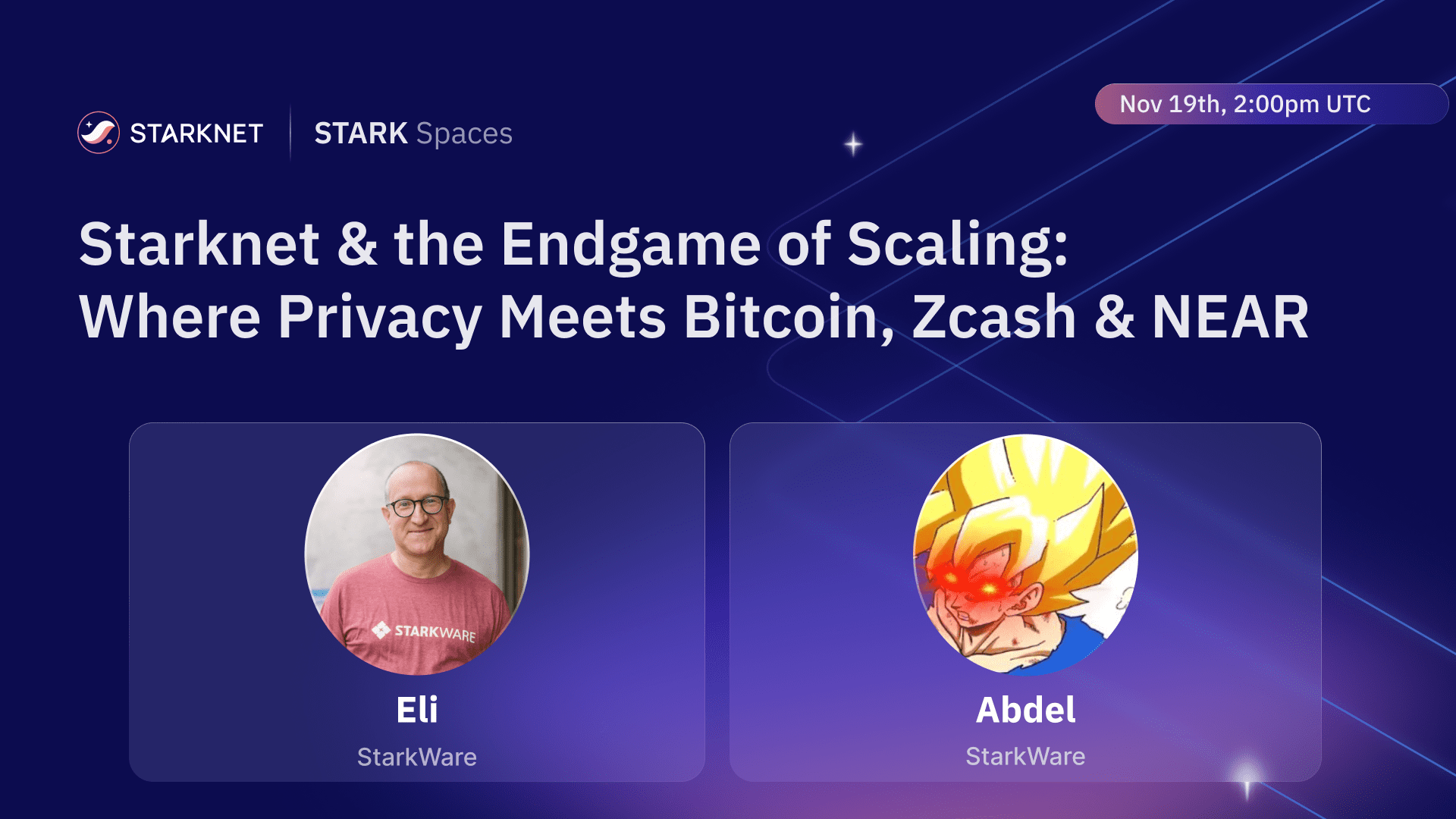
    Where Privacy meets Bitcoin, Zcash & NEAR

    In this long-form conversation, Abdel sits down with Eli Ben-Sasson, co-founder of Zcash and StarkWare and co-creator of STARK proofs, to explore how privacy, Bitcoin, ZK-STARKs, and post-quantum security all converge into one vision: a scalable, private, and future-proof hard money economy. The discussion starts with how the past months have felt like an inflection point: the world is waking up to topics that StarkWare has been obsessing over for years – privacy, post-quantum security, validity proofs, and building from first principles instead of chasing short-term narratives.

    Eli explains the original StarkWare vision and why the team chose to be trailblazing rather than EVM-copycat, even when it made ecosystem bootstrapping harder at the beginning. That same long-term mindset led to the development of Cairo, a lean, safe, ZK-native VM that Eli and Abdel describe as effectively the future of Ethereum.

    From there, they dive deep into Bitcoin and privacy. Eli explains why today’s Bitcoin privacy is effectively broken for normal users, and why a real Bitcoin economy needs a layer where people can put their BTC to work, generate yield, and still keep self-custody without relying on centralized exchanges. This is where BTCFi and Starknet come in: Starknet as a decentralized compute and settlement layer for “programmable encrypted Bitcoin” or “programmable hard money,” enabling scalable, programmable, privacy-preserving use of BTC.

    The conversation then moves to Zcash, NEAR and what Abdel calls the “Holy Trinity”: Zcash for strong privacy guarantees, Starknet as the scalable verifiable compute layer, and NEAR as UX and intent-centric glue. They talk about proposals like “Darknet” (Starknet settling on Zcash), the appetite of the Zcash community to embrace STARK-based scaling, and why Eli believes that every serious blockchain that survives the next 10-20 years will need STARKs baked in for scaling and post-quantum security.

    Abdel and Eli also look at the hard numbers and the current momentum on Starknet: growing TVL, strong net inflows, rapidly increasing DeFi and stablecoin usage, STRK staking crossing 20% of circulating supply in under a year, and real consumer apps like Focus Tree onboarding hundreds of thousands of users who don’t even realize Starknet is under the hood.

    This leads into a discussion of Starknet as “invisible infrastructure” for large-scale consumer apps, powered by account abstraction and UX that feels web2-native while preserving web3 sovereignty. They close by reflecting on fundamentals versus memes, why this return to real tech and values feels different, and what they hope to see in the next phase: Starknet as a core engine for the Bitcoin economy, a home for privacy-preserving applications, and a pillar of what Eli calls the “Integrity Web” – a world where more and more computation is verifiable, private where needed, and not controlled by opaque institutions.

    If you care about Bitcoin, privacy, ZK proofs, post-quantum security, hard money, or building serious applications on Starknet, this episode is a dense, honest, and highly opinionated roadmap for where things are going.