Every major blockchain has the same problem coming. Before quantum computers can break today’s signatures, each chain has to replace the cryptography that protects its users, and for most of them that means a hard fork and a coordinated migration of every account. Starknet made one core design decision at the start that changes this: account abstraction.
Because Starknet accounts are programmable, the rules that protect them can change too. That gives Starknet a different path to post-quantum security, and is one reason why an independent Starknet L1 is worth researching.
What account abstraction is
On Ethereum and Bitcoin, your account is your key. The address comes from an ECDSA public key, and the protocol itself decides that a valid signature from that key means a valid transaction. Changing the signature scheme means changing the protocol.
Account abstraction separates the two. Your account becomes a smart contract, and the rules for approving a transaction live in its code. That code can check a passkey, a multisig, a spending limit or a post-quantum signature.
Ethereum is adding this on top of its existing model with ERC-4337 and EIP-7702. Starknet started here. Every account on Starknet is a contract.
What quantum computers break
A large enough quantum computer running Shor’s algorithm can recover a private key from an elliptic-curve public key. That covers ECDSA account signatures, BLS validator signatures, KZG commitments and most SNARKs. Hash functions hold up. The best known attack on them, Grover’s algorithm, is answered with larger outputs.
The risk starts early. Any public key already onchain can be recorded today and attacked once the hardware arrives. So the real question for a chain is how fast it can swap out what’s vulnerable, and how many parties have to agree first.
Accounts that upgrade themselves
Every Starknet account has two entry points. __validate__ checks the signature, in whatever format the account chooses. __execute__ runs the transaction. The protocol enforces nonces, fees and a limit on validation, and leaves the rest to the account.
Because approval is code, it can change. The replace_class syscall swaps an account’s logic while its address, balances and history stay where they are. Three things follow.
- No fork. A post-quantum account is just a contract whose
__validate__checks a lattice-based or hash-based signature. The protocol stays the same. - The owner sets the timeline. Accounts move to a post-quantum verifier in place, with no new address and no network deadline.
- Agility after the first move. If a standard changes or a scheme weakens, accounts swap again.
On Ethereum, ECDSA is part of the protocol, and account signatures are one of several items on a multi-year post-quantum roadmap. Optimism has set a ten-year deprecation of ECDSA EOAs. Both need clients, wallets and users to move together.
Compare networks on what a post-quantum migration needs and the gap is clear. Starknet shows evidence for all eight capabilities. Bitcoin, Algorand and NEAR reach seven. Ethereum reaches three. The one capability no other network has is account change, the ability for an existing account to switch its signature scheme in place. That is account abstraction.
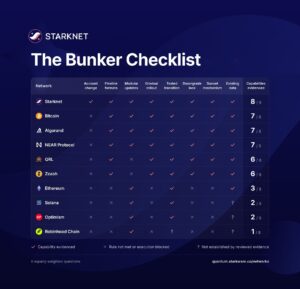
This already works on Starknet. S2morrow has shown a Falcon-512 account written in Cairo. OpenZeppelin has published Falcon-512 verifiers and account contracts, early and still unaudited. StarkWare’s Quantum Hub reports a post-quantum transaction on mainnet. Post-quantum signatures cost more today, and optimisation work is ongoing.
What account abstraction can do on its own L1
Accounts can only go so far on their own. As an Ethereum L2, Starknet settles on Ethereum, posts its data there and bridges through it, and all three still rely on elliptic-curve cryptography. However fast Starknet moves, it can only finish the job when Ethereum does.
Running those layers itself is the only way to set their cryptography and their timeline. That is the case for researching an independent L1, and account abstraction is what makes it work. A Starknet L1 would start with no externally owned accounts and no protocol signature scheme to retire. Ethereum has a large population of ECDSA accounts to move. Starknet’s accounts already choose their own verifiers.
Without the Ethereum dependency, the research opens up several directions:
- Protection all the way down. Upgrading an account would also bring post-quantum consensus, data availability and bridging beneath it.
- Post-quantum by default. Freed from Ethereum-compatible cryptography, new accounts could start post-quantum, with elliptic-curve accounts retired on Starknet’s schedule.
- One model for every key. Validator and system keys could rotate to new schemes the same way user accounts do.
- A faster response. If a scheme weakens, governance could upgrade accounts and infrastructure together, without waiting on another chain.
- Cheaper secure accounts. Starknet could tune validation limits and add protocol support for post-quantum verification as standards settle.
These are research directions for now. STRK stays the native token, no new token is planned, and existing Ethereum bridges stay open. Any move to an L1 would need its own binding governance vote. Starknet is not built around the idea that one form of cryptography will win. It is built so its security can adapt as cryptography evolves.